
Editor's note: The 2025 SMART Talks on Climate Change program, jointly organized by Yale Center Beijing and Yale Center for Carbon Capture, culminated in an essay competition where participants submitted essays on "What is a natural climate solution you have observed in your own context? How might implementing this solution at the local level create an impact on the global scale?" This is a piece written by one of the winners of the 2025 essay competition.
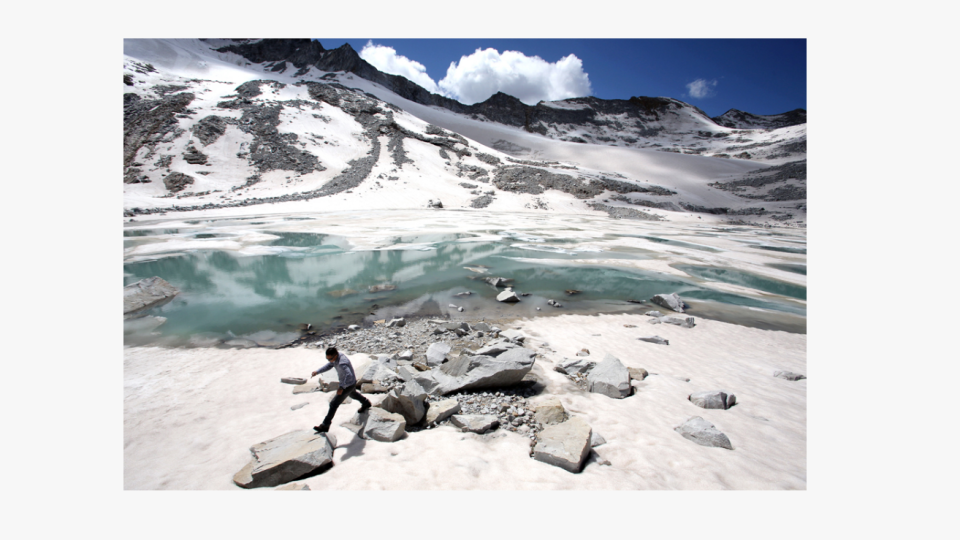
“Bang!” Our car suddenly came to a full stop while my family was mesmerized by the breathtaking view outside. It was summer 2019, and my family took a trip to Tibet. The solemn and sacred land not only showed us its grandeur and beauty, but also troubled us with fallen rocks and bumpy roads. Our car got stuck in a ditch on the side of the road and could not move despite the wheels spinning. Luckily, a group of Tibetan farmers working in the nearby fields rushed to help. They placed some rocks beneath the wheel to provide enough traction. But before doing that, one of them carefully examined the rock and gently blew away the ants and insects clinging to it. My father explained to me that Tibetans believe in equality of all forms of life and have developed passion and humility in harmony with the environment and nature.
The image of a humble Tibetan farmer bending over was much more powerful and overwhelming than the magnificent snowy mountains above us. Seven years after the incident, the memory ignited sparks when I attended the SMART Talks on Climate Change this summer. I had the opportunity to exchange with Professor Sunil Amrith at Yale Center Beijing and was introduced to his unique view of the impact of human activities on nature. In his book Unruly Waters: How Rains, Rivers, Coasts, and Seas Have Shaped Asia’s History, Professor Amrith shows that modern attempts to control water through large-scale engineering and centralized state planning have often fallen short of promises. He warns against our self-conceited tendency to dominate rivers and advocates for humility in our relationship with nature — wasn’t this the very mindset I witnessed among the Tibetan people during my family trip?

Glaciers on the Tibetan Plateau, known as Asia’s water tower, have been feeding rivers in South and Southeast Asia for millions of years. Today, China and India are competing to build dams on these ancient rivers. Deep in the valleys of the Himalayan Mountains, giant structures span across the landscape, flaunting a modern way of living and its triumph over nature. But the promises of economic opportunities are shadowed by disputes. In July, the Chinese government announced an ambitious plan to build the world’s largest dam on the Yarlung Tsangpo–Brahmaputra River. This mega project raises concerns in India, as it will significantly alter the region’s hydrology. Despite the Chinese government’s claims that the dam won’t impact the downstream water flow, some in India fear that the project could weaponize the mighty Yarlung Tsangpo–Brahmaputra River. Ironically, after the terrorist attack in Indian-administered Kashmir in April this year, which India blamed on Pakistan, India swiftly announced the suspension of the Indus Waters Treaty, which distributes the water flow in the Indus River basin, causing panic and a water crisis in Pakistan.
The distribution of water flow in cross-border rivers in the Himalayas has become a serious problem, leading to fresh conflicts among China, Pakistan, and India. Although agreements like the Indus Waters Treaty have played an essential role in maintaining regional stability, the insatiable desire to harness nature has prompted plans to build more hydro projects. Political tensions arise, along with some unintended consequences, such as forest degradation, wetland damage, and loss of biodiversity. Moreover, the region is known for its geological instability, and since we are still unable to predict seismic activity, the risks associated with these mega-projects cannot be fully assessed. Yet all parties involved treat the rivers as their sole property, exploiting them at the expense of their neighbors.
Both China and India have learned a hard lesson from their experience with a command economy, under which well-trained experts act as top designers and issue orders according to a master plan. It does not work. As Hayek points out, no one can possess the dispersed, tacit, and local knowledge required to efficiently allocate resources in a complex system. Therefore, central plans are doomed to fail and may even end in disasters. We might suffer from a similar fatal conceit in environmental engineering, since we haven’t set foot on every corner of the vast Himalayan region, let alone fully understand the delicacy of the ecosystem. As more dams are built, the long-run effects on the environment cannot be correctly predicted. We shall resist the temptation to think that we can envision all possible scenarios and design solutions for every problem. A humble attitude demands natural solutions such as protecting and restoring local forests and natural habitats. We should seek resilience through softness and flow with nature like the Tibetans, embodying Bruce Lee’s timeless wisdom: “Be water.”