
Editor's note: The 2025 SMART Talks on Climate Change program, jointly organized by Yale Center Beijing and Yale Center for Carbon Capture, culminated in an essay competition where participants submitted essays on "What is a natural climate solution you have observed in your own context? How might implementing this solution at the local level create an impact on the global scale?" This is a piece written by one of the winners of the 2025 essay competition.
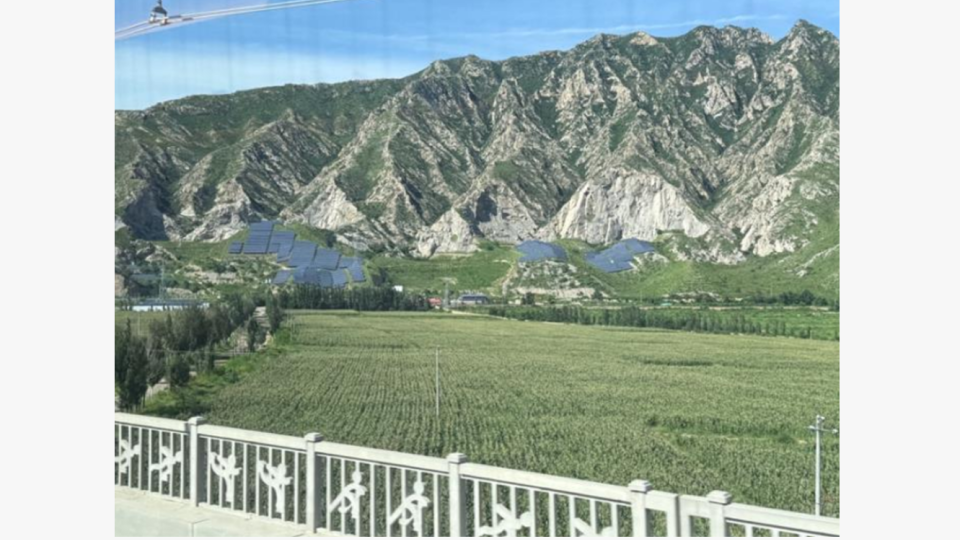
The endless agricultural lands are an unmissable spectacle for anyone aboard the train in China, regardless of which direction you are traveling. The brown green brown green whirls by the windows, leaving a sense of soothing beauty foreign to me, a city boy traveling back to my hometown for summer break. The trees and corn fields were lined up so uniformly, like sentinels, tightly packed together, basking in the sun.
What is especially appealing is that the scenery is very random. Other times, the soil may be bare; sometimes, the corns are toddlers just sprouting out; and sometimes, I saw large tractors tilling the soil, and dark-yellow dust floating in the air.
There are only scarce moments that I realized that these lands are the birthplace of the food we eat three times a day, every day throughout our lifetime. Agriculture is the basis of early, permanent settlement, the fuel of human civilization, and now, an overlooked aspect facing serious challenges from climate change to food insecurity, poverty, and public health. We have chosen productivity and profits at society’s and the environment’s sacrifice, while agriculture could be sustainable, healthy, low-cost, more profitable, and, most importantly, a solution to climate change.
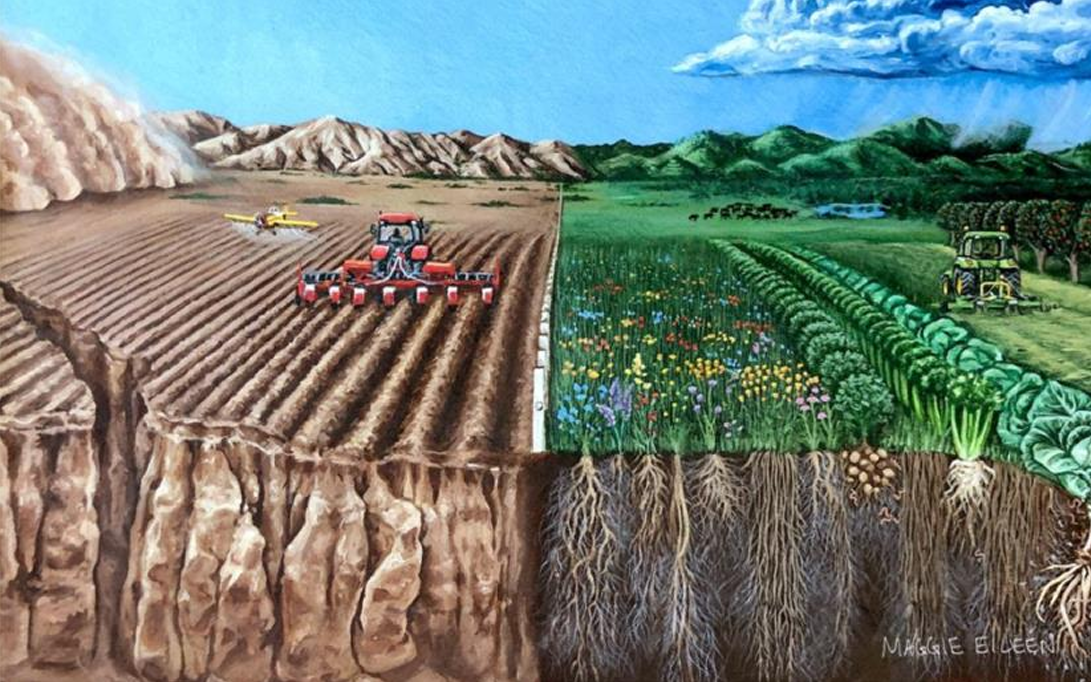
Since the Industrial Revolution and the Green Revolution, conventional agriculture—large-scale mechanical tillage, heavy use of synthetic inputs, and monoculture—boosted crop yields at the cost of soil health. According to the United Nations, a third of the soil globally has already degraded due to biodiversity and nutrient depletion from monoculture (United Nations, 2018). Repeatedly planting one crop depletes some nutrients, leaving others unused, while tilling leads to erosion of soil organic matter, losing the soil’s nutrient base. Thus, farmers heavily utilized synthetic fertilizers and further depleted the soil’s natural nutrients, creating a vicious cycle of reliance on costly and fossil fuel-intensive fertilizers. Similarly, pesticides became the only solution without biodiversity to keep pests in check. Yet, who wants pesticides in their food?

Most importantly, however, agriculture today is a net emitter of greenhouse gas. Conventional farming practices release the rich carbon content in the soil into the atmosphere, accounting for 10% of total annual emissions (Rodale Institute, 2014). The entire food system, including fertilizer and pesticide manufacturing, accounts for 30% of total global greenhouse gas emissions (Vermeulen et al., 2012).
In this era which climate change aggravates day by day, threatening livelihoods across the globe, restoring our agricultural system could be a crucial turning point, and it simply involves farming as we used to do it—farming in harmony with nature. Regenerative agriculture can not only avoid all the adverse effects of conventional agriculture, but it’s a climate solution, not a culprit. It could sequester more than 100% of current annual CO2 emissions by returning carbon into the soil, where it belongs (Rodale Institute, 2014).
Minimizing tillage and synthetic fertilizers, regenerative agriculture collaborates with biodiversity through crop rotation, agroforestry, cover cropping, etc. Soil is a carbon sink larger than the atmosphere and vegetation combined, and such practices put carbon into the soil. And this comes at no cost, but benefits farmers actually. Farmers profit more from higher yields that come from healthy soil, lower input costs saved from buying pesticides and fertilizers, and a higher selling price for organic produce. On the other hand, these foods grown on healthy soil are good for your health: they are 25-64% higher in vitamins, 32-329% higher in essential fatty acids, and 28-67% lower in oxidative stress markers (Brown, 2024).

The only obstacle to scaling up this climate solution is the resistance to transition and the fear of elusive risk. It is therefore our job—consumers, farmers, NGO workers, policymakers—everyone’s responsibility to streamline the transition. Everyone is a stakeholder, and implementation of regenerative agriculture on the local level would be critical in restoring local soil health, nourishing the environment, and those who consume the yields. And at the global level, it is a huge step toward reducing atmospheric carbon dioxide levels and combating climate change.
References
Brown, G. (2024, June). How regenerative agriculture brings life back to the land [Video]. TED Talks.
https://www.ted.com/talks/gabe_brown_how_regenerative_agriculture_brings_life_back_to_the_land
Galanopoulos, P. (2023, September 22). Regenerative Farming vs. Conventional Farming: A Sustainable Revolution. FuFluns’ Foods. https://fuflunsfoods.com/blogs/news/regenerative-farming-vs-conventional-farminga-sustainable revolution?srsltid=AfmBOoqQu7TPTRZ2YIdhNkVH6RWf5f5YznureGbqgyGMcbIU6FJEaCx4
Rodale Institute. (2014). Regenerative Organic Agriculture and Climate Change: A Down-toEarth Solution to Global Warming. In Rodale Institute. https://rodaleinstitute.org/wpcontent/uploads/rodale-whitepaper.pdf
United Nations. (2018, December 7). Soil pollution ‘jeopardizing’ life on Earth, UN agency warns on World Day. UNNews. https://news.un.org/en/story/2018/12/1027681
Vermeulen, S. J., Campbell, B. M., & Ingram, J. S. (2012). Climate change and food systems. Annual Review of Environment and Resources, 37(1), 195–222. https://doi.org/10.1146/annurev-environ-020411-130608